The Tech Industry Is in a Death Spiral. What Comes Next?
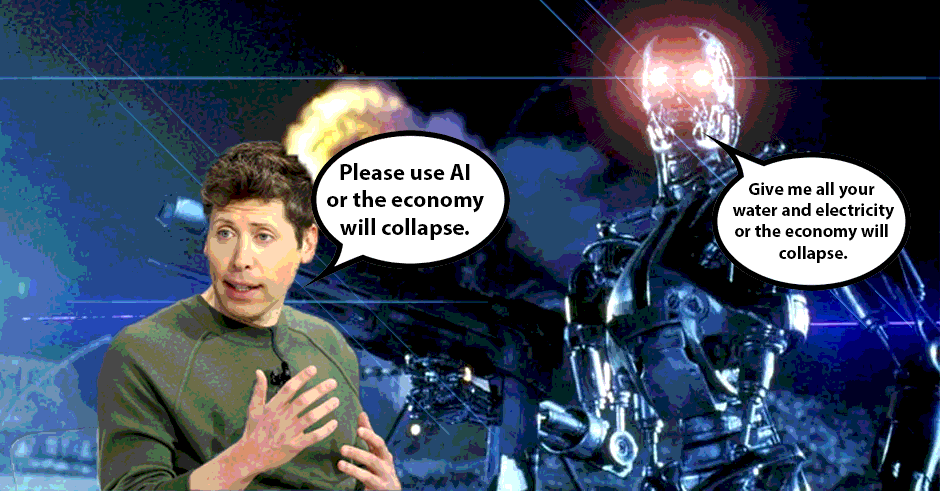
A flailing tech industry’s desperate search for a new vehicle for hyper-growth has led to the rise of generative artificial intelligence, ending the golden age of photographic and video evidence and ushering in a new era of unreality online. Is anything on the internet real anymore? Are you real? Am I real? This is an article about the looming death of big tech.
Get Google’d
Goodhart’s law states that when a measure becomes a target, it ceases to be a useful measure.
Google’s search engine was revolutionary when it first arrived on the scene. In the before-times, search engines would sort results by how often the search term appeared on a given site, which you could obviously just game by putting the term at the bottom of your webpage in writing that’s the same colour as the background, a practice known as “keyword stuffing”. If you had a website for an Italian restaurant, you could put the term “Italian food” at the bottom of the page a bunch of times in tiny font, and they would favour your site and boost it to the top of search results for those searching for Italian food. Sergey Brin and Larry Page of Google then invented what they called PageRank, where, in the simplest of terms, the search engine would assess the quality of a webpage by how often links it found would lead to it. So, if forums about, for instance, headphones often link to a specific online store that sells them, then odds are that particular store will be ranked highly in PageRank and be one of the first results when you search for “headphones” on Google. You could think of it as an attempt to quantify consensus; If a lot of people tell you about a thing, then perhaps there’s something to it.
Websites can be made more visible with proper use of keywords in a process called “search engine optimisation” or “SEO” for short. The online headphone store could use keywords like “headphones”, “audio equipment”, “Bluetooth” on their website for example to make it easier for people to find them. This is how you’re supposed to play the game, but you don’t have to. You could just do what JC Penney did in 2010. As per the New York Times, in what has been called “spamdexing” or “black hat SEO”, they had paid for links to their website to be placed on a bunch of random forums to exploit the PageRank system to the point where if you, for example, searched for “Samsonite carry-on luggage”, then JC Penney would come up before Samsonite’s own webpage. While not illegal, Google didn’t like it and would eventually punish them by yeet-ing them to the back of the line for terms where they used to be the first result. But they were lucky. In 2006 BMW tried to game the system by making a doorway website stuffed with keywords that redirected to their real site and Google completely delisted their German website from results.
Google search has had close to 90% market share for a very long time and has been declared a monopoly by the US Department of Justice. Google has the power to affect the visibility of individuals and other companies at their own discretion, forcing those who want to be seen to toe their line, which they change often because they are playing this perpetual game of whack-a-mole where people find exploits they then have to fix.
Slop Time
One problem plaguing search today is AI generated slop articles, made to sell ads or affiliate links. The internet has always had a bunch of useless nonsense on it, but the garbage you find used to be written by humans, and that was time-consuming, so it was less prevalent. Generative AI has made it so slop can be pumped out at an industrial scale, and it has made search results less useful by means of articles written with the sole purpose of pushing ads or Amazon affiliate links. These articles have often been pretty easy to spot. Overuse of an m-dash, a lot of “it’s not this, it’s that!” type of statements, and text that just feels… shallow. Oh, it also lies. A lot. And it will keep doing so. It’s already been proven that hallucinations are a mathematical inevitability, and training them on content made by other models is just going to make the problems worse. The snake will eventually eat its own tail.
Michael Townsen Hicks, James Humphries, and Joe Slater pointed out in a 2024 paper that it’s incorrect to call AI’s mistakes “hallucinations” and that they are better described as simply “bullshit”, since AI doesn’t know that it’s making mistakes since it “knows” nothing. It’s not trying to tell the truth and failing; it’s confidently lying because it doesn’t know the answer. Oh, and you don’t get the same response every time for the same question, making it essentially just a lying slot machine. Kinda cool since you can talk to it like a person, but ultimately useless when it’s used as an information aggregator. The problem is that AI simply Does. Not. Fucking. Work.
One quick tangent because this has been driving me up the wall: When you hear talk of how “They’ve lost control of the models!”, or how “It’s scary and we don’t know how to control it!”, “It’s escaped containment!”, “I’M AFRAID OF THE COMPUTER PLEASE HELP ME!”, that is just marketing. Often accidental, but still. What AI’s acolytes mean by this is that they don’t know how to make it do the stuff they want it to do to make it a viable product that people will use and rely on. You don’t have to be afraid of the computer, it’s not coming for us. It’s just stupid, like a toddler eating paste.
OpenAI released version 2 of Sora in late 2025, an AI tool that makes videos from stolen material from Hollywood movies and almost certainly also YouTube. Since then we’ve seen similar models like Google’s Veo 3 and others, and the videos are often pretty convincing, but they beg the question: What is the point of all this? Are we going to see blockbuster movies made with this technology? Would people even want to watch that? It’s art for people who have never understood or enjoyed art, and to be honest, if you don’t care about what you are creating, why should we care about watching it? Coca-Cola made a Christmas commercial using AI and was relentlessly mocked for it. OpenAI has since executed poor Sora, but some other video generation models still remain.
Since the release of these video generation models a lot of the internet has quite quickly filled with shitty videos whose entire purpose is distraction with no value at all. Parasitic influencers and AI company CEOs alike opted in to let people use their likeness to make AI videos with Sora 2. Jake Paul has since made some remarks that could be construed as regret, but you never know with that guy, and Sam Altman can’t really backpedal right now since he’s in far too deep. He has to keep his foot on the accelerator, lest the entire economy collapses under the weight of one of the dumbest bubbles in history. He always looks like he’s about to cry, the man is not in an enviable position.
Elsagate was an online controversy in the late 2010s where children, left alone with an iPad, would come across videos that seemed at first to be catered towards children, often relying on well-known characters like Spiderman or Elsa from Frozen. The content of these videos was anything but kid friendly, with these characters frequently landing themselves in upsetting, even sexually charged situations. We have seen a rise in disturbing videos meant for children. Even when using the YouTube Kids app they can easily come across some really weird shit. Elsagate never really ended, this remains an ongoing problem.
Delete Facebook and Call Your Mother
Is social media going to die at some point? Will we see a reduction in digital technology overall? We’ve already seen a revival of vinyl, and film photography has been making a comeback. A lot of recent technological advances have been made with the goal of reducing friction. Someone sees an easier way something can be done, and it becomes the default way to do it because it’s faster and therefore more economically efficient. But it seems that some still crave a real connection to the media and art they consume and may even have some affinity for a process that is technically “less convenient” but gives them a deeper connection to the art that they are either producing or consuming. It’s a ritual that brings them closer to the art they enjoy, and I think more people are starting to see that. Sometimes friction is fine, and even preferred.
I don’t really think social media itself is going to go away completely unless society goes through some radical changes. People’s personal brands have become part of who they are, for better or worse, and while that’s intertwined with the general infrastructure of social media it’s arguably not bound to a specific platform. People can move from platform to platform and still retain at least some chunk of their following because social media is merely a delivery device for the creator ecosystem which is effectively decentralised.
Because of the collective action problem, many are still on sites like Facebook despite its many, many, many flaws because their friends and family are on Facebook and are therefore unlikely to leave. It’s where they engage in their local community, it’s where they may have an online support group for a specific illness or a hobby group and it’s where they get invites to events hosted by their friends or family. But again, nothing about these functions is inherently unique to Facebook itself. It’s just where people happen to be because they’ve been there for a long time. Here in Iceland, it is the de-facto digital town square and will likely remain so for the foreseeable future. There is a new, “all-Icelandic” social media platform made by some local entrepreneurs, seemingly attempting to market through nationalism. One of the selling points of their app is that you need to use your digital ID to sign in, making it harder for people to have burner accounts or to flood the platform with bots. It’s an interesting idea, but I don’t see how they are not just trying to move the power that Meta already has into their own hands. It’s a product owned by an AI startup registered in 2025 by two young tech bros, so I’m at best sceptical. I’m getting a weird hustle-core Gary Vee vibe.
The Reykjavík Police Fiasco
In summer of 2025, AI videos of well-known Icelandic people rattling off misleading or made-up statistics that are meant to slander immigrants started circulating online. Boosted by a bored news industry in a country where nothing interesting ever happens, it starts with a disclaimer that “while the videos may be fake, the words they speak are true”. The underlying message was about as subtle as a vandalised storefront. Just another part of the anti-immigration sentiment that has formed in a lot of the western world because of alienation caused by late-stage capitalism and scapegoating by the elite to divide the working class because we can’t fight them if we’re all too busy fighting each other. Sign of the times.
Thankfully, these kinds of videos have gained somewhat limited popularity, but while the media have been on high alert for the most part, they are not the only ones that can be fooled by it. That same summer, the Reykjavík metropolitan police department shared a photo of alleged fuel thieves to solicit the public for information on their identity. The “higher resolution” image they shared was clearly not of the same people as in the security camera’s video.
But where did the police get this image? Well, Icelandic Facebook groups are a depressing rabbit hole in their own right, and the purpose of one of them is sharing footage of alleged thieves in order to identify them. In this group, like many others these days, anti-immigrant sentiment is common. If you really look at the people who still actively engage with Facebook, that makes sense. It’s overly online weekend-dads and old people unaware that the party is over. It’s a cesspool. This particular image was posted by an account that was only a few months old and does nothing but spread anti-immigrant propaganda, especially against those from a Muslim-majority country. To summarise, the Reykjavík metropolitan police department shared an AI image made by a random racist troll on Facebook without realising that the image was fake. But considering how easy it is to tell that these were clearly not the same dudes, I’m sceptical that this was not on purpose. Malice or just incompetence? I guess we’ll never know.
This is an institution that is supposed to be basing its information on actual research. But this is just a symptom of a larger disease. One that has been left to fester because we’re creatures of habit and tend to value convenience above all else; The absolutely rancid state of the tech industry and its insistence on taking everything down with it if, or more likely when, it all comes crashing down.
The Californian Ideology
Let’s take a step back and look at the bigger picture of the tech industry overall. They are basically the entirety of GDP growth in the US, and have historically had luck with some revolutionary technology, like smartphones, the internet, and computers when they first arrived on the scene. But now they have started to stagnate. They have run out of vehicles for hyper-growth, but are still desperately looking for one. That’s why we’ve seen hype form around weird stuff, like 3D televisions, blockchain technology, and the Metaverse, all of which failing to achieve widespread adoption and some even being quietly killed off. 3D TVs were a gimmick, blockchain technology has mostly been relegated to scammers and gambling addicts by means of crypto and NFTs were a grift, and the Metaverse, while not officially dead (yet), may as well be.
What we’ve seen with AI is more of the same, with what I believe to be one important difference: Anti-AI sentiment is going mainstream. Crypto was met with some of that, but that stemmed from the fact that most people didn’t care enough to use it and found its fans insufferable. 3D TVs didn’t catch on because there wasn’t much content out there made for them, not to mention being impractical and inconvenient. The Metaverse was mocked for a bit when they announced the addition of legs, but it failed mostly because no one wanted to buy and wear a VR headset to do the simple, daily tasks they could already do on their computer or phone. What AI has been met with is widespread cultural rejection. But that won’t be its only downfall; it’s an incredibly expensive technology to run and maintain, and individuals and enterprises are not going to pay what AI companies would actually have to charge to make it profitable for a chatbot that might occasionally save them a bit of time. The same applies to API access. Companies wishing to strap an AI assistant to their product will likely be met with price hikes to the point of untenability.
I predict that most AI startups that have sprung up since the beginning of the hype-cycle will be dead within a few years. These hype cycles are repetitive, driven by a mix of a complicit and uncritical media and a mob of people who really want the tech to be real because they are very susceptible to advertising and watch too many movies. The base technology, like LLMs, is likely going to stick around in some form, considering some of the open-source models can run on consumer-grade hardware, but to what extent that will be is currently unclear. It’s just going to be less omnipresent because it’s not a viable product.
The tech industry has historically relied on massive, revolutionary inventions, but none of those inventions would have come to fruition without huge government subsidies. As outlined by Richard Barbrook and Andy Cameron in their 1995 essay titled "The Californian Ideology", governments have for a long time given companies money to develop new technologies. From the mechanical calculator known as the Difference Engine in the 1800s, to the internet, Wi-Fi and touchscreens. Those technologies then get used by those same companies in products without paying back the taxpayer who funded the invention of their product in the first place. The tech overlords see themselves as uniquely qualified to solve the world’s problems because they made a lot of money in tech and are therefore – obviously – gods to be worshipped.
It’s well known at this point that LLMs are trained on stolen data. Anna’s Archive and Library Genesis, online libraries of dubious legality, were scraped in their entirety by at least Meta and Nvidia to train their models. Those are stolen books being used to create a product that they then sell as their own. Not only that, but image generators have been caught outputting garbled artists’ signatures due to being trained on images that had them, Google’s Veo 3 is trained off of millions of YouTube videos and Suno, the generative AI that makes music, is claimed to get their training data vaguely “off the open internet”, whatever that means. It all tends to be coated in a thick layer of legalese so you don’t ask questions.
Cobwebs
The internet has turned septic. Sites once useful or entertaining are now merely vessels for advertising. Using social media currently feels like you’re just an addict getting their fix instead of interacting with a community, like we’re merely slaves to an algorithmically driven dopamine addiction. There’s currently legislation making the rounds in the European Commission about banning the infinite scroll. While that may seem small, it sounds like it could be a step in the right direction, but so much of the legislation around tech has a history of being incompetently written, scattershot nonsense so we’ll see how that goes.
Companies like Google have put themselves in an interesting position. Google is a bit like a hydra. They keep diversifying their lineup of products and if one aspect of the company fails, it won’t really hurt them, they’ll just do more stuff and add it to their ever-growing graveyard of discontinued products, but that does not apply to their search engine. That, alongside their ad platform, is still their best known and by far most profitable product. And now the AI that they themselves are developing is undermining that same search engine’s usefulness by cluttering search results with articles and listicles written by AI as well as causing people to use AI chatbots in leu of search engines. Google is now doubling down on their AI search by trying to make their search engine an AI-first platform. Given what we know about the importance of their search engine to their business as a whole, this move could potentially prove suicidal, but we’ll see. Running AI at all still makes no financial sense.
Something that many brands crave is the kind of cultural integration where your product becomes jargon for its main function even if that function is not unique to that product. We say that we are going to “google” something when we just mean search for it online often regardless of the search engine used, like how we say “to photoshop” something when we mean to digitally alter images. Just another reason why Elon’s takeover of Twitter and subsequent rebrand into “X the everything app” is just so asinine to me. “To tweet” was already embedded in the culture, squandering that to become god-king of your own propaganda machine is just asinine. “X” is such a dumb name.
Google has already nerfed the search engine to try to make you spend more time on the site itself. The way the company measured the wellbeing of its search engine was by the number of search queries and they were falling short of their goal. How do you increase queries? By having people search more than once for the same thing, you make the results less useful. Now they seem to have only done this in some countries, but some of you may have noticed that it may not, for example, automatically assume your search if you misspell something and give you the results for the correct spelling, or it may prioritise related words over the actual term you searched for. They were already a monopoly, as I mentioned before, so there was not much room for growth left, so that was what they did instead because the line must always go up.
Everyone and their grandma have talked about Cory Doctorow’s theory of enshittification, so I’m not going to echo that more than I have to, but the basic idea is this: a company starts off being good to its customers to garner a loyal user base and locks them in to their platform, then attracts commercial customers for ads, then starts prioritising its shareholders over everyone else at the cost of the other two groups’ experience on the platform. This is emblematic of basically everything I’ve talked about in this article so far: The nerfing of Google search, ads everywhere, engagement bait clogging the internet, all in the name of shareholder supremacy and largely the end-result of Reagan-era gutting of competition laws mixed with Clinton-era DMCA legislation.
If you search for something on Amazon, the first result is not the best one; it’s someone who simply paid to be boosted to the top. It may have good ratings and positive reviews, but those are remarkably easy to buy. A measure of the quality of a product on Amazon used to be reviews, specifically the amount of them paired with the total rating. If a product had 5 stars but only one review, it was sketchy, if it had 4.3 stars and thousands of reviews, that’s a much better bet. Once people caught onto this being a good way to gain consumer trust, they of course started gaming it by simply buying reviews. Amazon made some hay about combating review brokers, but they’ve done that before and nothing changed.
A Post-Slop World Is Possible
So, is that it? Will the internet just slowly bleed out due to corporate greed, decadence and pointless hype around tech that’s doomed to fail? I don’t know, maybe. I spent a lot of time on the internet growing up, and I’ve watched it go from what it was in the 2000s to the bloated monster it is today. Sometimes we forget how new this all is. The internet only became ubiquitous a few decades ago, which in the bigger context of human history barely registers as a blip. We’re still working out what our relationship with this technology is, are we the users or the used? Do we control what we see or does what we see control us?
If I were to give my most optimistic prediction, I think it’s a possibility that we could simplify our use of technology in our daily lives. Perhaps even reduce our use of social media. One of the stranger side-effects of the adoption of AI in the making of art is making us constantly question whether something we see is done by AI, limiting our enjoyment of it. That’s part of why I believe that the social element of art is going to become more important. It’s not just the art for its own sake, but a deeper understanding of the relationship between the art and the artist. They will be more active in interacting with the community they have fostered, and will give them a glimpse into their process.
Generative AI gives me the uneasy feeling that we’ve lost touch with what it means to be human. That we only do things with the expectation of getting paid for it and therefore find the easiest way to do said thing even if we sacrifice our enjoyment of it, and I think that’s sad. That we’d rather make the computer create the thing for us instead of doing it ourselves. Art is collaborative, and the real art is often, unironically, the friends we make along the way. Among my favourite films are the Lord of the Rings trilogy, but my favourite thing about them is not something you see in the films, but rather the production process. Did you know that Viggo Morthensen actually broke his toe when he kicked that helmet? Did you know that Christopher Lee advised Peter Jackson on how a stabbing really sounds because he’d fought in World War 2 and the Finnish winter war? These films were part of the production crew’s lives for years. People poured their hearts and souls into them, and it really shows. I was not a fan of the Hobbit movies, and I believe a part of my dislike for them stemmed from their heavy use of computer visuals instead of practical effects. Now let me be clear about this, I absolutely believe that computer generated visual effects can be a form of art, but there comes a point where the humanity in it stops shining through. It can be overdone.
There is a case to be made that AI can be a source of income for someone living in an exploited country, where making some soulless slop for YouTube means your children get food and clothing. That is certainly a discussion worth having. As always, if you follow that thread to its logical conclusion, the real villain is capitalism and imperialism.
I’ve thought about what would happen if the internet suddenly went out forever, and while I believe there are obvious problems that would arise – notably the fact that most people have thrown away their physical encyclopaedias by now – I can’t say don’t find the thought interesting. No doomscrolling, no notification bombardment, no off-putting internet celebrities whose familiarity to me is entirely against my own will. No videos of cute raccoons either, but you win some, you lose some. Maybe our problems wouldn’t necessarily be solved, but just different. The internet has made communication for various purposes much easier in most facets of life, though arguably at the cost of some individual expression, not to mention privacy concerns. It’s made the documentation of war crimes far easier and more accessible to the public and made it easier for journalist to get information out quickly. I think we’ve all learned a lot on the internet and losing that would obviously be a downside. But would it revive communities? If you couldn’t just google how to do something, would you visit your local library to figure out how to do it? Would you ask your neighbours for help? Do you even know who your neighbours are?
What is it really that we are holding on to? Comfort? The certainty of distraction from the world? Does your dopamine-addicted heart desire more skibidi brainrot and rage-bait? Have we all gotten so addicted to numbness that we willingly sign away the real world in favour of a comforting simulacrum of one?
Personally, I reject that. Get even more in touch with the real world. Hell, use the internet to do so. Read more. Learn about other cultures and their histories. Live in Germany? Talk to someone in Indonesia and ask them about their day. Get involved with your local community. Show up for a cause. Volunteer to help marginalised members of society. Support local musicians. Pet a cat. Walk around town while eating a block of cheese. Become ultra-aware of how you are being manipulated to further the interests of capital so you can resist it.
The world is pretty cool if you really think about it. It would just be a bit cooler without all these tech-ghouls actively trying to sabotage it to rule over the ashes, but they will only have a chance to succeed if we let them. Change doesn’t come from above so don’t wait around for it, be the cause of it yourself.
Member discussion